Bring your models and your setup
Use the models
you already pay for.
First-class support for Anthropic and OpenAI, 17 built-in providers, local models through Ollama or llama.cpp, and custom endpoints that speak a supported API. New models and prices arrive in a signed model list, without a Caudra update.
Sign in to one provider with several subscriptions and API keys. Auto keeps each conversation on its account and moves it to another before the quota runs out, at a point where its prompt cache is cold unless the account is nearly spent. When every subscription of one provider runs out, Caudra can move the conversation to another provider you list, and the transcript records each move with its cause and cache cost. Accounts and quota shows how Auto decides.
Anthropic · OpenAI · Google · GitHub Copilot · xAI · Mistral · DeepSeek · OpenRouter · Z.AI · Ollama · llama.cpp
Providers and sign-in- ChatGPTSign in with your ChatGPT subscription.
- GitHub CopilotSign in with GitHub, or import an existing Copilot token.
- xAISign in with your xAI account.
- ClaudeSign in with your Claude subscription.Experimental
Claude subscription sign-in is experimental. Anthropic's terms limit Pro and Max subscriptions to official clients.
Keep the setup you have
Caudra reads the instruction files and skills you already have and connects to your MCP servers, so trying it does not mean starting over.
Instruction files
At session start, Caudra loads
AGENTS.md,CLAUDE.md,.cursorrules,GEMINI.md, or one of six other instruction file names.Skills
Caudra reads skills from
.claude/skillsand.agents/skillsfolders. Lauren Tan's pstack, 16 of Matt Pocock's skills, and 16 of Emil Kowalski's design-engineering skills ship built in, each off until you turn it on.MCP servers
Add stdio or HTTP MCP servers in
mcp.toml, with OAuth sign-in. The model calls them by writing Python in itscodetool, and Caudra speaks the current MCP protocol and the older one.Scripts
--printwrites the same JSON fields as Claude Code, so scripts that parse its output keep working. A print run saves its session, andcaudra --session <ID>resumes it.
A model for each job
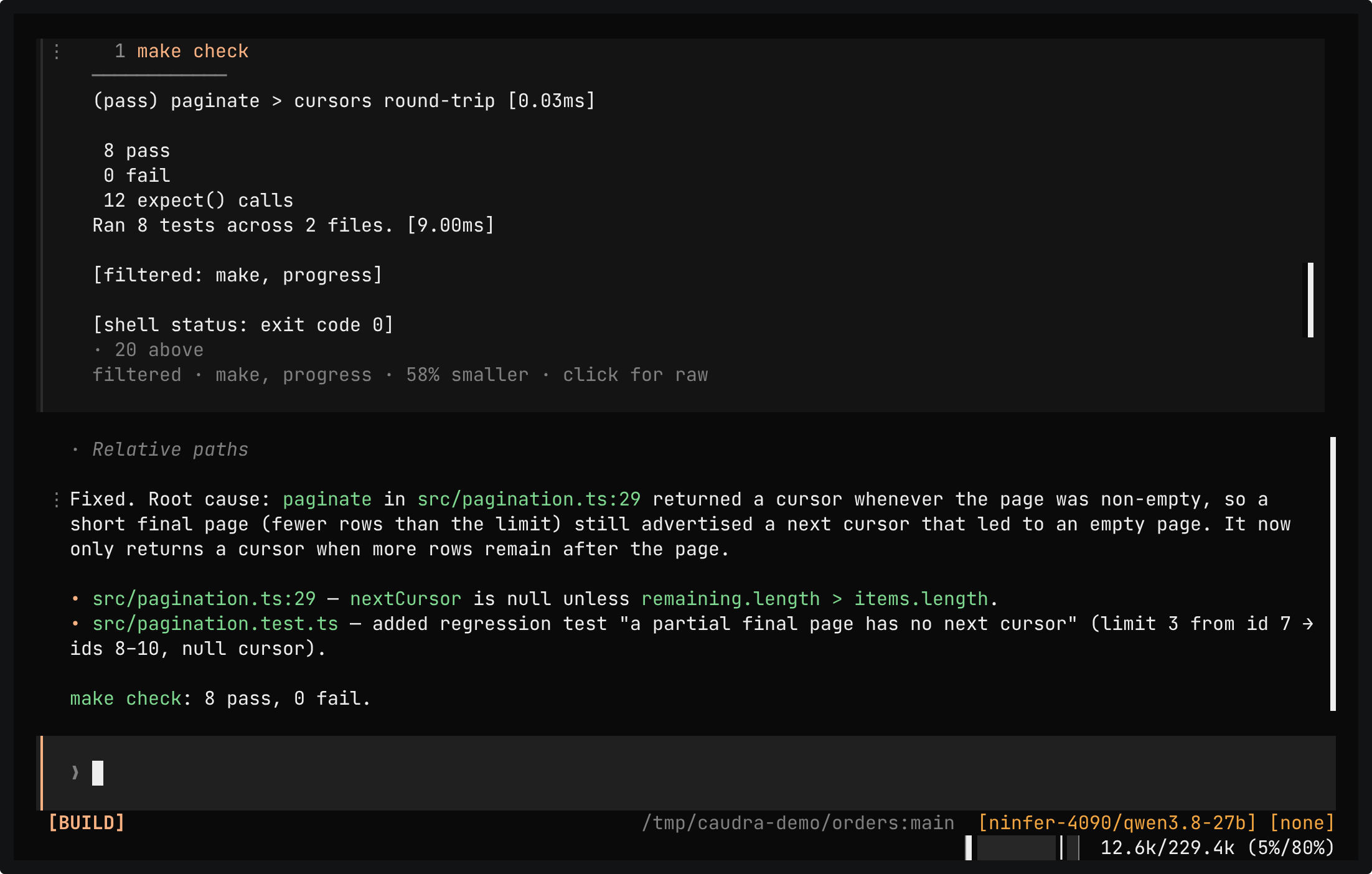
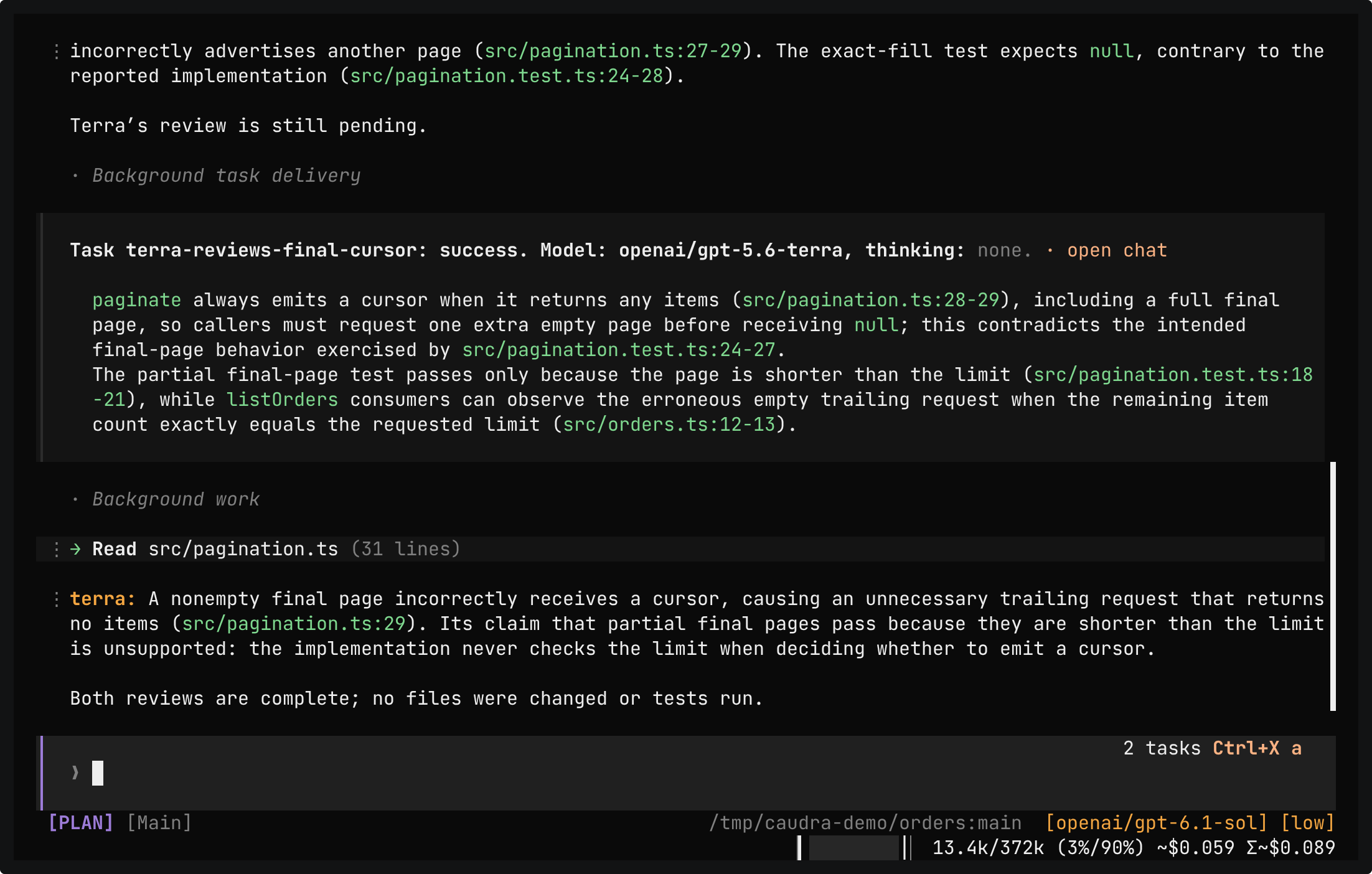
Model jobs decide which model serves each kind of work. Pin a job to a model in /model, or let it follow Chat, Plan, Fast, or Best. A local endpoint can name its own Fast and Best models in providers.toml. For a single task, name the model in your prompt, as in “ask opus and sol to review this change”, and each gets a task of its own.
Every model job
- Chat
- The main conversation. Picking a model in
/modelsets it. - Plan
- Main turns in Plan mode, on the Chat model until you bind it.
- Subagent
- Delegated tasks, on the parent agent's model until you bind it.
- Compact
- Summaries when a context window fills.
- Title
- Session names, on Fast until you bind it.
- Goal
- The
/goalevaluator, on Fast until you bind it. - Extract
- Requirements for
/extractand compaction, on Fast until you bind it. - Memory
- One-line summaries of older memory notes, on the compaction model until you bind it.
- Learn
- The continual learner, on the Chat model until you bind it.
- Autopilot
- Answers for autopilot while you are away, on Best until you bind it.
- Fast
- The preferred small model, for routine calls.
- Best
- The provider's flagship. Point Plan or a prompt profile's subagents at it.
The decision engine can route new subagents to the Fast or Best model. Decisions and reranking explains what else it judges.
Model jobs