01When you step away

Step away.
Autopilot keeps it moving.

Autopilot answers what would otherwise wait for you, so a session keeps working toward its goal while you are away. A completion goal decides when the work is done, and your permission rules still decide what may run.
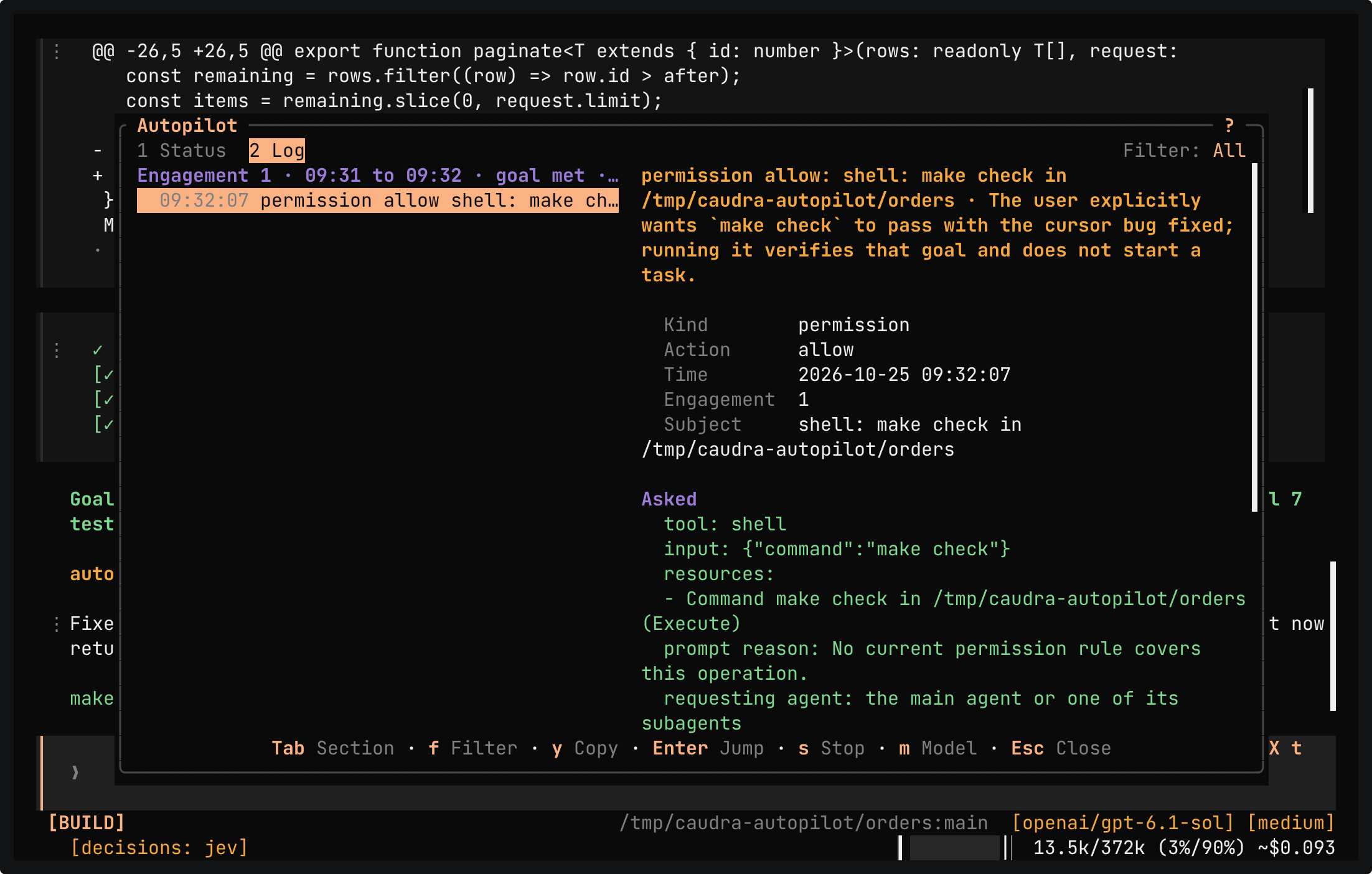
The Autopilot panel on its Log tab. Engagement 1 ended with goal met, and its one entry reads permission allow, shell: make check, with the reason that the user wants make check to pass with the cursor bug fixed. Below it the panel shows the request: tool shell, input make check, and the prompt reason that no current permission rule covers it.

Terminal recording · Autopilot toward a goalA real session in a demo project with no stored rules, with gpt-6.1-sol in Build mode and content screening of the jev-latest decision engine in enforce mode. /autopilot sets the goal that make check passes with the last-page cursor bug fixed, and the footer shows the goal and the autopilot chip. The agent fixes src/pagination.ts. When make check asks for approval, autopilot allows that one call and the transcript row gives its reason. No rule is stored. The goal check passes, and a row ends the engagement. /autopilot log lists the decision with what the delegate was asked and why.Open in the gallery
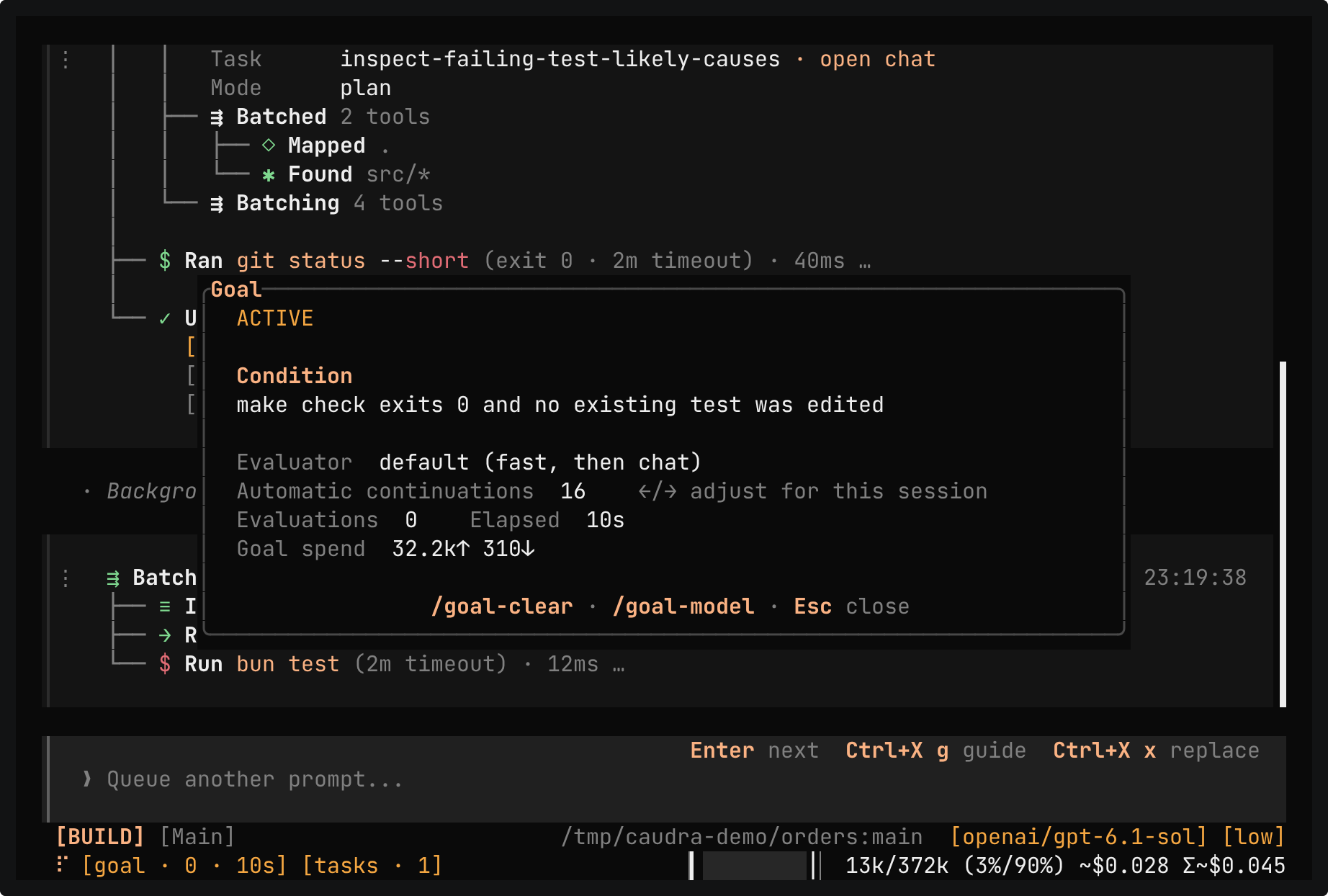
The goal panel over a working session. It reads ACTIVE, the condition make check exits 0 and no existing test was edited, the default evaluator, 16 automatic continuations, 0 evaluations after 10 s, and the goal spend so far.

Terminal recording · Work toward a goalA real session in the demo project. /goal sets the condition make check exits 0 and no existing test was edited. The panel shows the condition, the evaluator, and the limit of 16 automatic continuations. The agent fixes the bug, and after the work turn a separate evaluator finds the goal met and clears it.Open in the gallery
  • Engage it with one command

    /autopilot <goal> sets a completion goal and engages. Only you can engage it. Scripts, profiles, and the model cannot. --autopilot engages the session Caudra starts with.

  • Answers what would wait for you

    A separate model call, the delegate, answers permission prompts, the question tool, questions asked in prose, and a plan that is ready to implement. It never runs tools, and it leaves what it cannot decide safely to you.

  • Approvals that end with the call

    An approval covers one call and adds no rule. Protected files, sudo, and tools that always ask are never approved, and nothing is approved after content screening flags a result or cannot screen one in full.

  • Budgets and a log

    An engagement ends after 100 continuations by default, and you can cap its spend and its minutes. Decision calls count toward that spend. /autopilot log lists every decision, what the delegate was asked, its reason, and what followed.

  • Goals that check evidence

    After each work turn, a separate model call with no tools reads the transcript. An unmet goal starts another turn. A met goal clears itself. A goal that waits on CI or a deploy is checked again later, and three turns without progress end the run. /goal log lists every check with its model, cost, and reason.

  • Permissions that read the command

    Shell chains and pipelines split into separate commands for approval. Approve once, for the conversation, the project, or every project, and accept patterns Caudra suggests from repeated approvals.

  • Plan first, then hear back

    By default, new sessions open in Plan mode, where the agent edits only its plan and asks before commands it cannot prove read-only. Notifications tell you when a turn finishes or a prompt needs your answer.

Unattended work needs a running session, for example in tmux or Herdr. Closing it stops background work, and when you reopen the session, the main turn and its subagents resume. Shell commands are not run again. When nothing screens fetched pages, engaging autopilot says so. Autopilot is delegated consent and no security boundary. /goal looks for evidence in the transcript. It does not prove the work is correct.

How autopilot works